
Newsletter
Join the Community
Subscribe to our newsletter for the latest news and updates
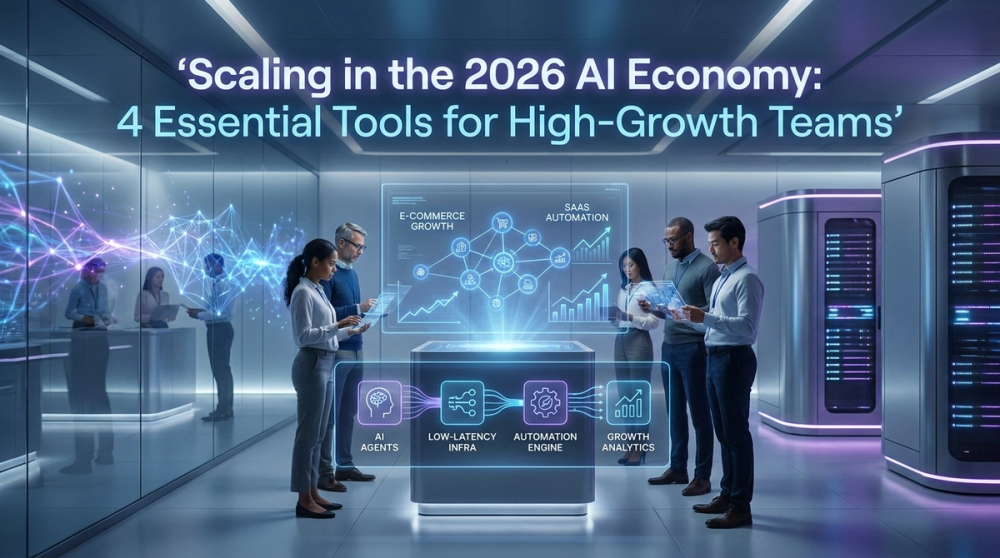
Discover how the latest AI agents and low-latency infrastructure are redefining e-commerce growth and SaaS automation in mid-2026.
2026/06/08
At ToolsGazer, our editorial team evaluates AI solutions based on three core pillars: Integration Speed, Operational Reliability, and Cost-to-Output Ratio. For this review, we deployed these tools within a sandbox e-commerce environment to simulate real-world high-traffic scenarios, specifically looking for 'agentic autonomy'—the ability for a tool to complete a workflow with minimal human steering.
Core Features: Blink.new is an AI-native full-stack app builder that allows founders to create web and mobile applications simply by describing them. It uniquely supports one-click deployment for autonomous AI agents like OpenClaw.
Why We Like It: In 2026, the gap between idea and execution has vanished. Blink.new is the primary reason why. Its ability to host agents in under 60 seconds makes it the ultimate 'speed-to-market' weapon for lean teams.
Core Features: DigiStorms acts as an intelligent layer over your SaaS, tracking user behavior in real-time and triggering personalized email sequences designed to convert free-tier users into paid subscribers.
Why We Like It: Most e-commerce and SaaS 'leaks' happen during onboarding. DigiStorms plugs these holes by acting as a 24/7 customer success manager that never sleeps and scales infinitely.
Core Features: Pulze.ai provides a secure environment to build complex AI workflows using over 50 frontier models. It features intelligent routing to ensure the best model is used for each specific task while maintaining SOC 2 compliance.
Why We Like It: As teams scale, security becomes a bottleneck. Pulze.ai solves this by offering enterprise-grade guardrails for no-code builders, allowing for secure automation without a dev-ops team.
Core Features: Google’s latest iteration of the Flash series, optimized specifically for low-latency, high-volume agentic workflows. It is the 'engine' behind many of the fastest agents in the 2026 ecosystem.
Why We Like It: In the agent economy, latency is the new downtime. Gemini 3.1 Flash provides the near-instant reasoning required for real-time customer interactions and rapid data processing.
| Tool | Primary Use Case | Key Strength | Best For |
|---|---|---|---|
| Blink.new | App Development | Speed to Deployment | Solo Founders |
| DigiStorms | User Conversion | Behavioral Automation | SaaS/E-commerce |
| Pulze.ai | Workflow Security | Model Orchestration | High-Growth Teams |
| Gemini 3.1 Flash | Logic Engine | Ultra-Low Latency | Agent Developers |
Explore our curated selection of the most powerful autonomous tools in the 2026 Agentic Power Stack and start scaling your operations today.