

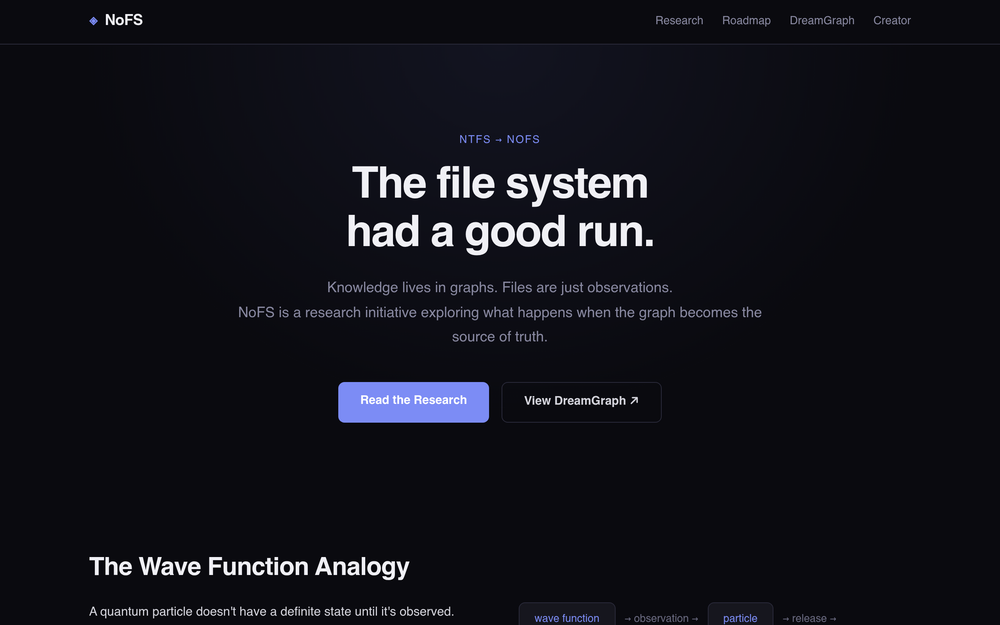
NoFS is a revolutionary approach to data management that challenges the traditional concept of file systems. Instead of treating files as static entities, NoFS views them as dynamic projections derived from a underlying graph of truth. This shift in perspective enables a more flexible, interconnected, and powerful way to organize and interact with information.
Core principles of NoFS:
- Graph-Centric Data Model: All data is represented as nodes and edges in a graph, allowing for rich relationships and contextual understanding.
- Dynamic Projections: Files are generated on-the-fly as specific views or projections of the underlying graph data.
- Versioned Truth: The graph maintains a complete history of changes, providing a reliable and auditable record of information.
- Interconnectedness: Information is inherently linked, enabling seamless navigation and discovery across different datasets.
- Scalability and Performance: Built to handle massive amounts of data and complex relationships with high efficiency.
- AI-Native Integration: The graph structure is ideally suited for AI models to explore, analyze, and extract insights from.
NoFS aims to empower users with a more intuitive and powerful way to manage their data, moving beyond the limitations of hierarchical file systems and into a future of interconnected knowledge. It is particularly well-suited for applications involving complex data relationships, knowledge management, and AI-driven insights.