
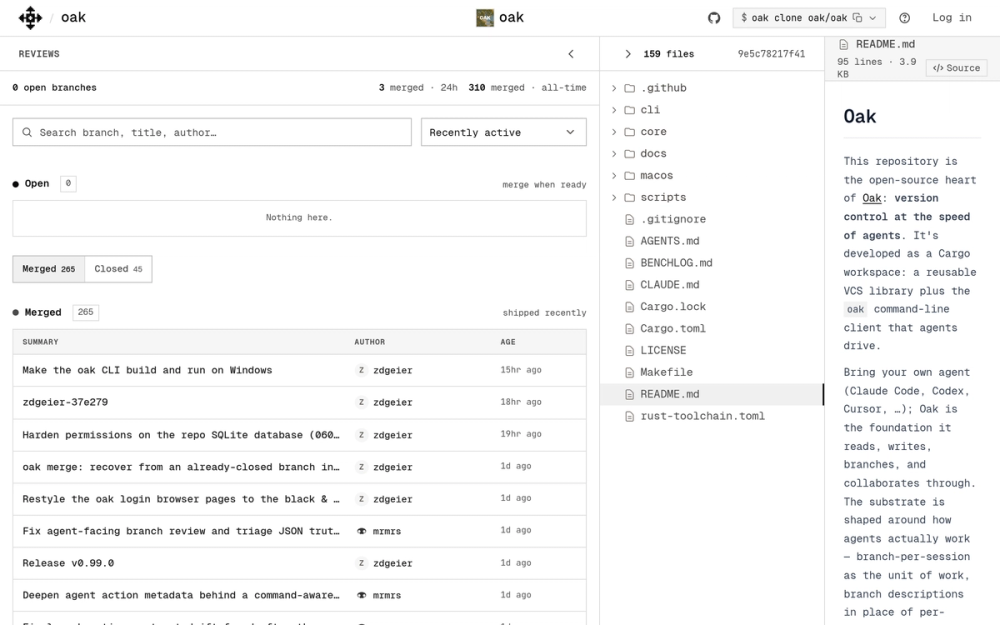
Oak is a groundbreaking version control system specifically engineered to meet the demands of the rapidly evolving AI-driven development landscape. While traditional tools like Git have served as the bedrock of software engineering for decades, they were inherently designed for human workflows, with complex command structures and branching logic that can be suboptimal for autonomous AI agents. Oak rethinks version control from the ground up, offering a streamlined Git alternative that simplifies the interaction between AI models and their codebases.
By focusing on the specific patterns of agentic behavior, Oak provides a programmatic and highly reliable state management layer. This allows AI agents to create checkpoints, track incremental changes, and manage project history with significantly higher precision and lower cognitive load for the underlying LLM. In an environment where an AI might perform hundreds of micro-commits during a single task, Oak ensures that every step is documented and reversible without the overhead of traditional staging areas or merge conflicts. This level of reliability is essential for developers building sophisticated agentic workflows, autonomous coding assistants, and self-healing software systems.
The performance of Oak is optimized for speed and efficiency, ensuring that the versioning layer never becomes a bottleneck during intensive AI operations. It offers a developer-friendly experience that bridges the gap between human oversight and machine execution. By using Oak, engineering teams can empower their AI agents to work more independently while maintaining full visibility and control over the codebase. As we transition into a future where agents are primary contributors to software projects, tools like Oak provide the necessary infrastructure to maintain stability, traceability, and productivity. Whether you are scaling an AI-driven startup or integrating autonomous agents into an established enterprise workflow, Oak delivers the specialized version control needed for the next generation of technology. It is not just a tool, but a foundational component for the future of agentic software development, ensuring that your AI projects remain organized, efficient, and resilient.