
Newsletter
Join the Community
Subscribe to our newsletter for the latest news and updates
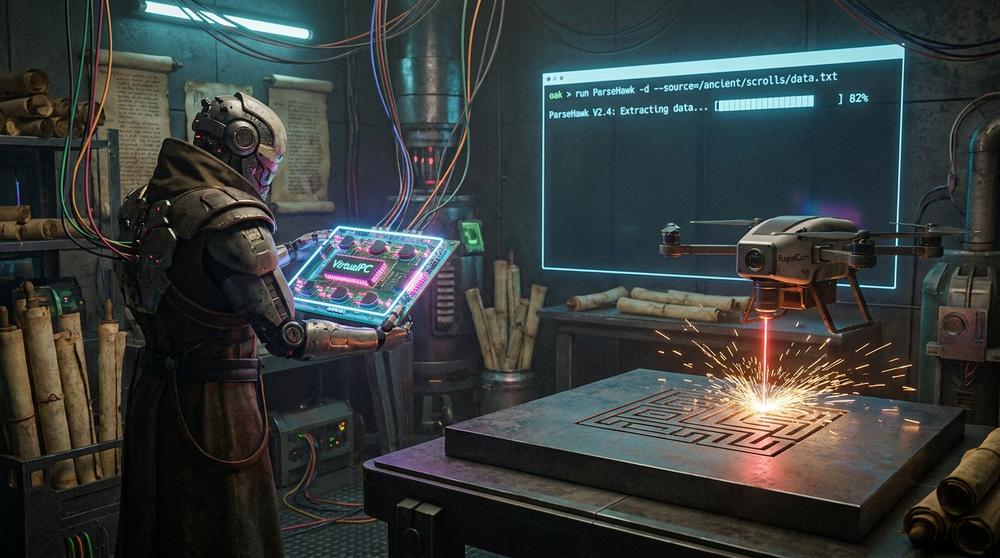
We field-tested the latest surge in local AI and agent-native infrastructure. From NAND-gate simulations to Git alternatives for agents, here are the tools redefining the technical stack this week.
2026/06/27
To cut through the 'vibe-coded' noise of 2026, our laboratory subjected these tools to a rigorous 72-hour stress test. We evaluated them based on three specific pillars: Latency-to-Action, Local Privacy Integrity, and Agentic Autonomy. Unlike generic reviews, we deployed these tools within a sandbox environment to see how they handle real-world autonomous workflows without human intervention.
As agents take over the bulk of codebase management, standard Git has become too verbose. Oak is the first version control system built from the ground up for autonomous entities. It strips away human-centric friction and optimizes for machine-readable diffs.
In an era of data leaks, ParseHawk provides a 'fortress' for your sensitive PDFs and internal docs. It's a 100% local document AI platform that allows for deep data extraction without a single packet leaving your network.
VirtualPC is where high-level AI meets low-level engineering. It features an 8-bit computer constructed from a single NAND gate, paired with a live-evolving neural net. It’s an alchemist’s playground for understanding the roots of computation through an AI lens.
Manufacturing is the next frontier for agents. RapidCam brings parametric 2D CAD/CAM directly to the browser. Designed specifically for CNC and laser cutting, it allows agents to generate manufacture-ready files from simple natural language prompts.
| Tool | Primary Use Case | Privacy Level | Agent Compatibility |
|---|---|---|---|
| Oak | Version Control | High (Local/Hybrid) | Native (P0) |
| ParseHawk | Data Extraction | Absolute (100% Local) | High (API-driven) |
| VirtualPC | Research/Edu | High | Experimental |
| RapidCam | Manufacturing | Medium (Cloud-based) | High (Parametric) |
The trend is clear: Local-First is the new standard. As we move deeper into 2026, the value moves from the model itself to the specialized tools that allow those models to act securely and autonomously.
Ready to equip your stack? Explore our curated Architect's Combat Pack for the full deployment guide.